Monday, April 28, 2008

Joseph Speakman's Balanced Appraisal of the CCC

At Work in Penn's Woods: The Civilian Conservation Corps in Pennsylvania

By Joseph M. Speakman

Pennsylvania State University Press, 2006


I don’t know that you’ll find a more balanced appraisal of the CCC than this book; it’s an elegant piece of scholarship. Joseph Speakman manages to hit all the high notes while reminding us that the CCC was, after all, a government program, and as such, it was far from perfect.

Speakman comes by his interest in the CCC naturally – like many of us his father gained from the program as a young man and the stories told seem to have ignited the fire of interest. That said, Speakman has gone into the task of scholarship with his eyes open and he seems to have remained so to the end. The result is a study of the CCC that is both interesting and informative without a whiff of an agenda.
Each of us remembers things a certain way, for a particular reason, even if we don’t in fact realize we are doing so. The experiences of Speakman’s father serve as something of an allegory for the way we have chosen to recall the CCC and its impact on this nation and the young men who rose from being the Great Depression generation to become The Greatest Generation. In the preface to Penn’s Woods, Speakman recounts that his father’s stories of having gained twenty pounds of muscle in the CCC were offset somewhat by the fact that his CCC discharge indicated he gained just nine pounds during his enrollment in the CCC.

With this seemingly inconsequential statement, Speakman sets up something of an overarching metaphor for his entire account of the work of the CCC in Pennsylvania. Specifically this: that while we may often gravitate toward the positive and uplifting aspects of the CCC, there are underlying truths that remain unpleasant at times. The CCC did not offer the same opportunities to young men of all races. The CCC occasionally squandered resources. The CCC did attempt to be too many things to too many people over the course of its lifetime. Speakman has done a terrific job of documenting these shortcomings, while avoiding the trap of revisionist polemics.

At Work In Penn’s Woods is well documented with a substantial list of sources and notes. Speakman makes a point of apologizing early on for his use of statistical data, but he weaves the statistical material so seamlessly through the narrative that it easily becomes another useful part of the story. This book will easily find a place in the canon of CCC literature and should be on the reading list of anyone who is interested in the New Deal or the CCC.


To visit the Pennsylvania University Press web page for At Work in Penn’s Woods, go here:

Monday, April 14, 2008

The Two Faces of Camp F-33-A, Mayer, Arizona

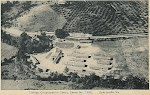
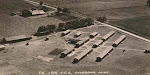
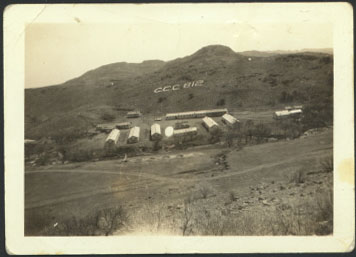
IMAGE: Camp F-33-A, Mayer, Arizona Circa 1939

After the dissolution of the CCC in 1942, former CCC camps were used for a number of purposes, in many cases being dismantled and moved to other sites for use by the military. Some camps were used to confine Axis prisoners of war, while others were used to house conscientious objectors who, due to religious beliefs, chose not to enter the military, opting instead to work in camps to perform useful, non-war related work. One of the more unfortunate uses of former CCC camps was as internment centers for the relocation of Japanese-Americans.

Camp F-33-A was established in Mayer, Arizona in the fall of 1933 and CCC companies alternated between the Mayer camp and other camps over time. Work done by CCC enrollees at the Mayer camp included twig blight control, trail construction, telephone line construction, bridge building, rodent control and erosion control.

Camp F-33-A served very briefly as a temporary relocation camp for Japanese-Americans who had been relocated from southern Arizona. Nothing remains of the camp today; the area has been swallowed up by homes and a small business area alongside the road through town. A Circle K convenience store dominates the area where once stood the camp. According to a National Park Service website, the Mayer camp was occupied for a shorter length of time than any relocation camp, with the internees being moved to the Poston Relocation Center less than a month after arriving at the Mayer camp.


During its life as a CCC camp, F-33-A was an integrated camp, with enrollees from a mixture of racial groups. Integrated camps were a rarity during the CCC’s lifetime and given the camps later use, its diverse racial make up in the 1930s is ironic.

To see the National Park Service website detailing the use of the Mayer CCC camp as a temporary internment camp for Japanese-Americans, visit this website:
http://www.nps.gov/history/history/online_books/anthropology74/ce16c.htm

Today you would never know that a CCC camp once stood along this stretch of Arizona highway, but if it were still standing, camp F-33-A would occupy the very middle of this picture.


Sunday, March 30, 2008

Happy Birthday C.C.C.!!

Today, when a single government agency can’t conduct its business efficiently, let’s remember back 75 years when four federal agencies provided meaningful work and training to millions of young men over the course of nearly a decade.


Seventy-five years ago today, a conservation army was mustered for duty in the forests, fields and parks of this country to begin what would ultimately be more than nine years of continuous work. The conservation army that undertook this peaceful occupation was Franklin Roosevelt’s Civilian Conservation Corps- the CCC. Among the results here in Arizona: trail systems in Grand Canyon, visitor amenities in South Mountain and Papago Parks, improvements at Colossal Cave and forestry improvements in all of our national forests. Nationally, the work of the CCC stretches from Acadia in Maine to Yellowstone in Wyoming, from Gettysburg in Pennsylvania to La Purisima in California. In fiscal year 1937 alone the CCC built a total of 2,476 vehicle bridges, 11,559 miles of truck trails and they strung over 10,000 miles of telephone and power lines, largely to the benefit of our National Forests and National Parks. Multiplied over 9 years, the numbers become almost incomprehensible and the fact that we continue to derive benefit from this work three-quarters of a century later is unfathomable in our modern throwaway society.

In a cooperative effort not seen before or since, the Departments of War, Labor, Agriculture, and the Interior, worked together to select suitable enrollees, provide medical checks and inoculations, issue supplies and work clothes and arrange transportation to the many camps scattered throughout the United States and its territories. The CCC was not run by the military. The camps – usually home to about 200 enrollees – were placed under the command of a reserve military officer, but military discipline was prohibited and enrollees were only under the control of the commanding officer during their hours in camp. In fact, many of the reserve officers called up to run the camps were themselves unemployed because of the national economic crisis and thus, they had a good deal more in common with the enrollees than some historians have been inclined to point out. During the workday, enrollees labored and learned under the watchful eye of foremen and supervisors from the technical services such as the Forest Service, National Park Service, Bureau of Reclamation and the Soil Conservation Service.


Ultimately, some 3 million young men passed through the ranks of the CCC between 1933 and 1942. Enrollees were housed, clothed, fed and paid $30 a month, of which as much as $25 was sent home to needy family members; after all, what good was $30 in the pocket of a lad living in a forest camp? The economy needed dollars to circulate and the monthly CCC allotments helped make that happen. Furthermore, the establishment of a CCC camp typically meant an additional $5,000 in monthly expenditures in the local marketplace because the camps bought many supplies locally, which created jobs in communities nationwide.

The work and history of the Civilian Conservation Corps is largely forgotten. Reinvigorated enrollees lay down their shovels to take up the fight against fascism. The “boys” of the CCC became the men of Corregidor, Midway, Anzio and Omaha Beach. Vocational skills gained in the CCC camps were put to use in our factories building tanks and airplanes. Nearly to a man, former CCC enrollees will tell you that the CCC was the best thing that ever happened to them, but as a nation we tend to remember more about the World War they fought between 1942 and 1945, than we do the quieter time from 1933 to 1942 when our nation was home to the Civilian Conservation Corps and its peaceful occupation.

In honor of this special day, here are some interesting CCC and New Deal anniversary links that have appeared on Google and elsewhere recently:


A nice remembrance appeared in this morning's online edition of the Deseret News out of Salt Lake City.

An interesting page from channel 8 in Austin, Texas. Included on the page is a link to a video clip. I don’t think any state beats Texas for its consistent, enthusiastic recognition of the work of the CCC
http://www.news8austin.com/content/your_news/default.asp?ArID=204161

A nifty article that ran in USA Today a few days back. National coverage like this is rare and usually comes out only during a significant milestone event or anniversary, but it’s still nice to see the coverage and some recognizable faces and names among those being interviewed.
http://www.usatoday.com/news/nation/2008-03-18-ccc75th_N.htm

Here’s a blog post from the California State Parks, announcing a special 75th anniversary exhibit to run at the state capitol. Also noted are observances at parks around the state.
http://yubanet.com/regional/75th-Anniversary-of-CCC---Civilian-Conservation-Corps.php
The CCC alumni and preservation group is known as CCC Legacy. CCC Legacy is the result of a merger between the National Association of CCC Alumni and the Camp Roosevelt Legacy Foundation. CCC Legacy has headquarters at both Jefferson Barracks, Missouri and Edinburg, Virginia. On the organization’s web page you’ll find links to events that are planned for the 75th anniversary as well as links to local CCC alumni newsletters and websites.
http://ccclegacy.org/
The original website for the National Association of CCC Alumni is still up as well. There is a very useful list of camps organized by state, as well as a selection of CCC items like caps and T-shirts available for purchase. You can visit that site here:
http://www.cccalumni.org/
For an example of the ill-informed sort of information that gets posted and published about the Civilian Conservation Corps, check out this blog, if you've got two minutes to waste. (I hope to make a post about this sort of ignorance some time in the future.)

Sunday, March 16, 2008

The Birth of the Civilian Conservation Corps


March 31, 2008 will mark the 75th anniversary of the creation of the Civilian Conservation Corps. Today, in an era when individual government agencies seem to have difficulty conducting the people's business, it should astound us to know that the CCC brought together the efforts of multiple federal agencies for a nearly decade-long effort that successfully employed and trained some 3 million young men as our nation stood on the cusp of war. Perhaps more amazing is the fact that, while the embryonic notions of melding work relief and conservation were in Franklin Roosevelt's mind well before he was elected president, the legislation to create the CCC passed through Congress in just 18 days.


Here then is a timeline of significant events connected to the creation of the Civilian Conservation Corps. Much of this information is from John Salmond's incredible book on the Civilian Conservation Corps.


1910
Franklin Delano Roosevelt takes over the family estate at Hyde Park and immediately begins a reforestation effort.

1931
Roosevelt sponsors an amendment to the New York constitution giving the state government authority to acquire and reforest marginal lands with funds created from the sale of bonds.

1932
July 2

In accepting the Democratic presidential nomination, Roosevelt proclaims that he has, “a very definite program for providing employment…,” through the establishment of a conservation program.
1933
January
James Couzens, a Republican senator from Michigan fails in his attempt to pass a Senate bill authorizing the use of the Army for unemployment relief. Though a failed effort, Couzens’ measure introduces the concept of military involvement in relief efforts.

March 9
Meeting with advisors, including the Secretaries of the interior, agriculture, and war FDR diagrams his plan to put 500,000 men to work on conservation-related projects. He asks Colonel Kyle Rucker, Army judge advocate-general, and Edward Finney, the solicitor of the Department of the Interior to prepare draft legislation, requesting they complete the task by days end. Roosevelt is given a draft document at 9 that evening and further discussion is conducted immediately.

March 14
Roosevelt confides to Raymond Moley, a member of his so-called “brain trust” that he intends to move forward with his plan to create a conservation oriented work relief program. Moley suggests a deliberate approach. Heeding Moley’s advice, Roosevelt sends a memorandum to the secretaries of war, interior, labor and agriculture, asking them to form “an informal committee of the Cabinet to co-ordinate the plans for the proposed Civilian Conservation Corps.”

March 15
At the request of President Roosevelt, the secretaries of war, interior, agriculture and labor meet to discuss the creation of a “civilian conservation corps.” In this initial meeting, the secretaries considered a number of aspects of the proposed conservation work program, including their recommendation that the work be strictly limited, ideally to forestry and soil erosion projects and not toward public works projects, so as not to compete with employers in the open market.

At his third press conference, held the same day his “informal committee” meets, Roosevelt expounds on the proposed forestry work program, including the proposed wage of $1 a day. Roosevelt explains that swift action on the matter is a foregone conclusion.

March 21
Roosevelt’s message concerning the “Relief of Unemployment” is sent to the Congress. In this message Roosevelt outlined a three-pronged attack on the problem, with the first effort being, “the enrollment of workers now by the Federal Government for such public employment as can be quickly started and will not interfere with the demand for, or the proper standards of, normal employment.”

More specifically, Roosevelt uttered what may be the most often quoted phrase in connection with the Civilian Conservation Corps:
"I propose to create a Civilian Conservation Corps to be used in simple work, not interfering with normal employment and confining itself to forestry, the prevention of soil erosion, flood control and similar projects. I estimate that 250,000 men can be given temporary employment by early summer if you give me authority to proceed within two weeks."
Roosevelt went on to state:
"More important will be the moral and spiritual value of such work. The overwhelming majority of unemployed Americans who are walking the streets and receiving private or public relief would infinitely prefer to work. We can take a vast army of these unemployed out into healthful surroundings."

Following the President’s message at bill entitled “The Relief of Unemployment Through the Performance of Useful Public Work and for other Purposes” was introduced into both the Senate and the House.

Labor leaders quickly condemn the plan for its wage and recruitment provisions and because of the involvement of the Army.

March 22
Roosevelt calls members of the Senate Committee on Education and Labor, and the House Committee on Labor to the White House where he explains his CCC plan in more detail and attempts to allay the fears expressed by organized labor and members of the Socialist party.

March 23-24
Joint Senate and House hearings begin in an atmosphere of cooperation possibly due to Roosevelt’s evening meeting at the White House the night before. Presiding over the hearings is Senator David I. Walsh, a Massachusetts Democrat and chairman of the Senate Committee on Education and Labor. Walsh prods the proceedings forward in an effort to adhere to Roosevelt’s stated desire.

Among those testifying at the Joint hearing is Chief forester Major Stuart who testified at length regarding the need for forest workers. Stuart also makes a successful bid to broaden the program’s scope of work to include not just national forests but also state and private forests. Without such a change, Stuart argues, there will have to be a transfer of men from east of the Mississippi River to the Rocky Mountain region where 95 percent of the public domain is situated. (With 70 percent of the unemployment located east of the Mississippi, it didn’t make sense to transport men westward to give them work.)

Stuart is also quizzed on the issue of paying enrollees $1 a day when the regular wage for forestry workers runs in the neighborhood of $3 a day. Stuart stresses the program’s function as a relief measure and explains that skilled $3 a day workers could serve as supervisor’s and foremen, with a clear distinction between the two wage scales.

Secretary of Labor, Miss Frances Perkins also stresses the programs aim of work relief when questioned about the proposed $1 a day wage for enrollees. She explains that most of the workers are expected to be young, single men and that the CCC should not be viewed “in the sense of providing real wage-producing employment.”

Army chief of staff, General Douglas MacArthur testifies that there will be “no military training whatsoever,” with the military restricting its participation to gathering the men selected by the Department of Labor, outfitting the men, giving the men a physical examination and physical conditioning before transporting them to their camps where they would be turned over to the Department of Agriculture.

The next witness is William Green, president of the American Federation of Labor. Green attacks the program on three points: regimentation of labor, low wages and funding. To Green the mandatory allotment and the involvement of the military “smacked of fascism, Hitlerism, of a form of Sovietism…” Green argues that the CCC wage of $1 a day would establish that as the national wage for workers. Other labor representatives also testify and the hearing adjourns on a far less optimistic note than it convened.

March 27
An amended S. 598 is reintroduced into the Senate. In response to the objections raised by labor, it was agreed that the focus should be on the two aspects of the program for which there were no objections from any side: the chance to perform forestry work as a means of relieving unemployment and the use of unobligated funds to pay for the program. The re-submitted bill merely authorized the President to work in the public domain, perform reforestation and employ unemployed citizens to perform the work.

In the House opposition to the bill is more robust and broad based. Despite indications from labor leaders that the $30 monthly wage would not be contested, an effort was launched to set the pay scale at $50 a month for single enrollees and $80 a month for married enrollees.

March 28
The senate bill is passed by voice vote over dwindling opposition, with minor amendments and in part because of the continuing efforts of Senator Walsh.

March 29
The House considers the bill amended and passed by the Senate on March 28th. Representative Connery stood to protest the proposed wage and dramatically announced that once again, labor leaders had again changed their position and now opposed the bill. Still another faction stood to argue that the measure imparted nearly dictatorial powers on the president and would lead a majority of the population believing that “it is the Government’s duty to put them on the pay roll.”

Nevertheless, the intent of the bill receives wide support in the House, with many recognizing it as focusing on relief of unemployment, not wage control. Representative Thomas G. Cochran of Missouri, stated that he disliked many of Roosevelt’s proposals, but admitting that “…I do like the way the President of the U.S. is trying to meet this emergency…”

Like Senator Walsh in the senate, Representative Robert Ramspeck, a Democrat from Georgia, carries the torch for the bill in the House, emphasizing the emergency nature of the legislation and its important relief function.

Connery’s proposal to set the monthly wage at $50 fails, along with a last minute effort by Republicans to delay proceedings. Only three amendments are adopted, including that proposed by Representative Oscar De Priest, a Republican from Illinois and the sole African-American Congressman. De Priest proposed “that no discrimination shall be made on account of race, color, or creed…under the provisions of this Act.”

The bill is passed by a voice vote.

March 30
The Senate accepts the House amendments to the bill and it is forwarded to the President.

March 31
President Roosevelt signs into law the legislation creating the Emergency Conservation Work (ECW) program and the Civilian Conservation Corps is born.

April 17
The first CCC camp is established in the George Washington National Forest in Virginia.

In an article titled “Rizzo Goes To Work,” Time magazine reports that a week earlier, 19 year old Fiore Rizzo reported to the Army Building in downtown Manhattan and reported for duty as the first CCC enrollee. The CCC is off and running!


Friday, January 25, 2008

Important CCC Anniversary Event Announced!

I am indebted to Bob Audretsch at Grand Canyon National Park for sharing an important press release regarding what will likely prove to be a very interesting Civilian Conservation Corps anniversary event later this year at Grand Canyon’s South Rim.

Like many of the forests and parks where the CCC worked, Grand Canyon National Park existed before the New Deal, and the advent of the CCC, but the park is far different today than it would have been were it not for the work of the CCC.

Here is the press release:

Grand Canyon Celebrates CCC Anniversary

On March 31, 1933 President Franklin Delano Roosevelt signed legislation creating the Civilian Conservation Corps and on May 29 the first CCC boys arrived at the Grand Canyon. The Grand Canyon Association and Grand Canyon National Park will mark this seventy-fifth anniversary with an exhibit and a symposium titled “Saving the Park and Saving the Boys, the CCC at Grand Canyon, 1933-1942.” The exhibit, May 31-October 31, will be at South Rim Village Kolb Studio and free and open to the public. A formal opening reception will take place the evening of May 30. The exhibit will start with a symposium featuring scholars, a panel of CCC enrollees, and history walks, May 31 and June 1. Registration for the symposium will begin January 31 by going to the parks website: http://www.nps.gov/grca/historyculture/ccc.htm

Exhibit goers will learn about the despair of the Great Depression, the fear of a possible ‘lost generation’ of young men and the feeling of hope that the CCC brought to poor unemployed young men and their families. Many historic photographs and artifacts, never before viewed by the public, will be on display. Attendees will learn about the many things the CCC accomplished at the Grand Canyon and the positive changes it brought to CCC boys and their families.

The exhibit has been in the planning stages for over two years and is funded by donations from the Grand Canyon Association. Exhibit team members include Bob Audretsch, James Schenck, Pam Frazier, Pam Cox and Michael Anderson. For more information contact Audretsch at bob_audretsch@nps.gov or 928-638-7834.

National Park Service historian John Paige said the CCC advanced park development 10-20 years during the program’s first two years. Some have called the 1930s the ‘golden years’ of the park service in large part due to the almost unlimited labor pool provided by the CCC. Grand Canyon National Park had as many as four companies with 200 boys each working simultaneously. Ultimately seven different companies worked at Grand Canyon: 818, 819, 847, 2543, 2833, 3318 and 4814. The most significant CCC accomplishments at Grand Canyon include trail building, the South Rim Community Building, the beautiful stone wall in the Village, the trans canyon telephone line and trail shelters.

Sunday, December 23, 2007

C.C.C. Side Camps

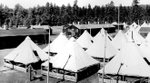
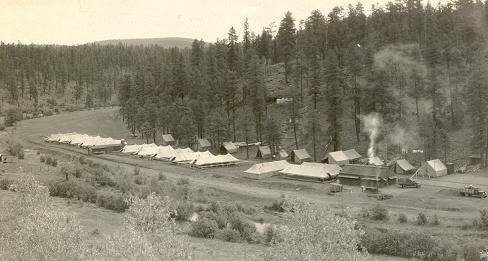
Life in a Civilian Conservation Corps side camp could be rustic to say the least. In this post we'll take a brief look at how the side camps were set up.


While most CCC camps were situated close to the main project site where the enrollees worked, there were also many, many work sites in remote places that needed the attention of CCC workers. It simply wasn’t practical to transport enrollees over miles and miles of remote roads to these work sites, and then return to camp at the end of the workday. To resolve this dilemma, smaller camps known as “spike camps,” “side camps,” or “fly camps” were established. But no matter what they were called, those small non-permanent camps established well away from larger CCC camps, were responsible for an astonishing amount of useful work that otherwise would not have been possible.

Side camps were initially an area of dispute. The technical services wanted the side camps placed under their control, an arrangement that both the Army and director Fechner opposed. Since the operation of the main camps was under their control, the Army reasoned that it should also be in charge of the side camps, with the technical services taking charge of the enrollees during normal work hours.

In July1933, President Roosevelt approved the establishment of side camps and he placed them under the control of the technical agencies with the requirement that not more than 10 percent of the company strength be assigned to them. One reason for Roosevelt’s decision may have been that, to place an army officer in each side camp would have stretched the military organization too thin, leading to a decline in management and leadership throughout the program. Despite their being exempt from direct Army control, there were guidelines on the layout of the side camps. For example, a Forest Service plan for a 25-man camp provided for five canvas tents, each 16 by 16 feet to house the enrollees. Three tents measuring 9 by 9 feet provided shelter for supervisory staff. The mess unit operated out of a tent measuring 19 by 21 feet and additional shelters were provided for the kitchen, the cook, the infirmary and office, as well as latrine and shower facilities. Even in these smaller camps, the provision was always made for a flagpole, usually placed in a central location in the camp area.

Forest Service plans also provided guidelines for a mobile 25-man camp, which consisted of 12 two-man shelter tents, three staff tents, one cook tent and a tent to serve as a combination mess and kitchen. Despite the lack of Army involvement, life in a mobile camp may have been quite similar to life in an infantry platoon. Each man was to be supplied with an infantry pack, canteen and mess kit. In the mobile configuration, the need for a kitchen unit could be eliminated if each enrollee carried five days of rations with him and the crew returned to base camp on weekends to re-provision.


Wednesday, November 21, 2007

The Night Before Christmas (with apologies to Clement Clarke Moore)


Twas the night before Christmas when all through the camp
The captain went strolling with a kerosene lamp.
The tools were all hung in the tool shop with care,
In hopes that Kris Kringle soon would be there.
With the enrollees nestled all snug in their bunks,
The Captain went prowling for raccoons and skunks.
The foremen in wool socks, the LEMs in their shorts,
Were snoring away in a chorus of snorts.

When out by the flagpole there arose such a noise
The captain was worried it might wake his boys.
Away to the mess hall he flew like a flash,
Thinking some dog robber was sampling the hash.
The moonlight on a forest covered in snow
Gave luster of midday to the camp below
When, what to the captain’s tired eyes should appear,
But a shiny stake bed truck rolling up in high gear!

With a little old driver, whose bells gave a jingle,
The captain knew right away it must be Kris Kringle
Smoother than silk that little REO ran
And Old Kris gave a chuckle and waved his gloved hand.
The captain couldn’t be sure, but gazing from afar,
Old Kris Kringle looked a bit like FDR.
Kris pulled the truck up to the mess hall in a slide
Then bounded up the stairs and went inside.

The captain rushed up to peek though the door
Naturally inquisitive, wanting to see more.
Kris didn’t make a sound but kept his eye on the ball,
As he expertly spruced up the camp mess hall.
Red garlands and green streamers he tacked up with care,
Knowing that hungry peavies soon would be there.

A huge holiday feast he prepared in a flash,
Turkey and dressing with no sign of hash!
And over it all Kris spoke a whispered prayer
For the families back home whose boys wouldn’t be there.
“Keep them safe and happy,” Kris whispered with a sigh
And with a gloved hand, wiped a tear from his eye.
Then, having completed an honest night’s work,
Kris turned toward the mess hall door with a jerk.

Then back to the little work truck he dashed
And lifting the clutch, the gas pedal he mashed.
To see that truck speed through camp was a sight,
But the captain knew it would be a busy night.
Kris Kringle had to hustle and be on his way
To visit all the CCC camps before light of day.
But the captain heard Kris exclaim with a flash of headlights,
“Merry Christmas CCC Boys and to all a good night!”

Buffalo Crossing Camp, Eastern Arizona

Buffalo Crossing Camp, Eastern Arizona