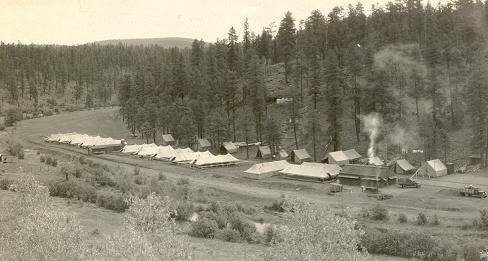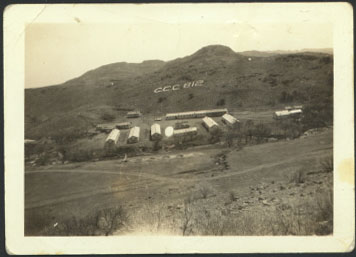



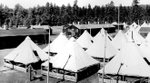
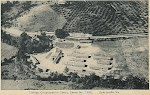
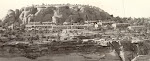
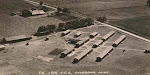
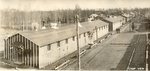
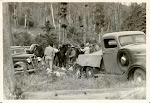
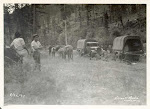
Would you tell these guys the CCC was a failure?
It is refreshing to see that the authors of the latest revisionist editorial to come out against the New Deal have wisely chosen to leave out any mention of the most popular and arguably the most successful New Deal program, the CCC.
Burton and Anita Folsom, who both hail from Hillsdale College, wrote earlier this month (ironically, on the anniversary of FDR’s death) that the New Deal did nothing to end the Great Depression. The editorial appeared in the Wall Street Journal and you can read it Here.
Referring to the many “alphabet agencies” created during the New Deal, Folsom and Folsom state that “…the WPA, AAA, NRA and even the TVA (Tennessee Valley Authority) failed to create sustainable jobs.” (I think someone working for the TVA today would beg to differ but that’s an argument they’ll have to make.) For my part I see it as a sign of progress that nowhere in the Folsom’s editorial is there any reference made to the CCC, the ECW or the Civilian Conservation Corps.
I’ve stated many times over that I am not an economist and I’m really not much of an historian and I don’t pretend to be. I’ve made a study of the CCC but when it comes to the larger impacts of the New Deal, I’ll defer to anyone with a reasonable argument. However when a revisionist historian props up their argument by making spurious claims about the CCC, they’d better have their facts straight. For this reason, I’m inclined to applaud the Folsom’s, at least for their having had the good sense to leave the CCC out of it.
I’m reminded of a revisionist rant that came out about five years ago from a gentleman by the name of Richard Ebeling – also associated with Hillsdale College at the time. Mr. Ebeling penned a piece entitled “When the Supreme Court Stopped Economic Fascism in America,” in which he made the following, stunning claim about the Civilian Conservation Corps:
“Much of the urban youth of America were rounded up and sent off to national forests for regimentation and mock military-style drilling as part of the Civilian Conservation Corps (CCC).
You can read the entire editorial here: Richard Ebeling's Article.
I won’t bother to expound on the many ways in which Mr. Ebeling’s claim is outlandish and stupid – he’s a professor of economics who should probably stick to economics – but I will offer some commentary on why I think the Folsom’s were right to leave the CCC out of their argument.
The CCC was not established to create sustainable jobs. If anything the CCC was geared toward removing single, teenaged men from the workforce in order to open up jobs for older men who were often unemployed heads of households. Furthermore, the CCC was created with the goal of improving the health and well being of its enrollees while providing them a chance to help their families through their own hard work (real self-esteem building, not the phony stuff sociologists spout about today). The money an enrollee sent home every month was plowed back into the economy in the form of rent payments and weekly grocery purchases. The CCC wasn’t a cure all and nobody with a lick of sense will attempt to argue that it was. By the same token, nobody with a lick of sense would reasonably claim the New Deal was a failure because of anything the CCC did, except perhaps with respect to its failure to racially integrate the camps.
I’m pleased that we can still discuss the New Deal on its merits and I’m pleased that supporters and detractors can all have their voices and opinions heard. I’m especially pleased that in the last five years or so, we’ve at least learned where the salient arguments are to be made and that the success or failure of a single New Deal program isn’t sufficient evidence for either side and that perhaps the CCC in its own right has risen above the discussion about whether or not the New Deal brought us out of the Great Depression.
To see an earlier editorial regarding revisionist works by Amity Shlaes (The Forgotten Man) and James Powell (FDR’s Folly) see my post entitled The Folly of Revisionist History.
Monday, April 19, 2010
Revisionist History: Leave the CCC Out of It

Tuesday, April 6, 2010
Semper Patria Mea: A New Look For Camp Commanders
 We now know when the insignia worn by the camp staff was changed. But why?
Larger developments and policies that shaped the program between 1933 and 1942 are widely known or at least vaguely understood but often the little facts behind the implementation of the policy are seemingly lost to history – buried deep in a stack of boxes in the National Archives perhaps.
Folks who’ve made a study of the CCC will have noticed that at some point in the lifespan of the program, the officers who ran the camps switched uniforms and their insignia changed from the familiar insignia of the U.S. military to an insignia created specially for the CCC. Bob Audretsch has located an article that spells out this change in the April 13, 1940 issue of Happy Days.
 Under the headline "Eagle and Latin Phrase for Officers", the article reads:
Washington, D.C. – CCC camp officials are to get a new corps insignia to replace the regulation one now used on CCC uniform hats. Devised by the war Department on request of Director James J. McEntee, the insignia will resemble the drawing above. Specifications now are being drawn by the Army Quartermaster.
The design, somewhat similar to that of the Army, will be of jewelry bronze, 2 ½ inches high, with raised letters. The Latin quotation at the bottom, “Semper Patria Mea,” means “Always My Country.” It was chosen by Director McEntee. The design was executed by the heraldry office of the War Department.
The reason for the switch lies buried in a bureaucratic maneuver that took place in 1939. The War Department was never 100% on board with participation in the CCC program; they were a reluctant partner at first and eventually grew into a grudging participant, having recognized a number of benefits that could be derived from their participation in the CCC program. Nevertheless the relationship between CCC Director Fechner and the War Department was never a close one and by 1939 the War Department was taking steps to have itself absolved of responsibility for the camps.
A move by Congress in April 1939 only served to push the divorce along. On April 3rd Congress voted to give full disability benefits to Reserve officers assigned to active duty with the CCC; this was an expense the Roosevelt administration could not sanction and in response he decided to replace all Reserve officers assigned to CCC camps with civilians and the changeover was complete by the end of 1939. Nevertheless, the War Department remained in control of the camp administration, but the change in policy explains why the insignia of camp personnel was undergoing the changes that are outlined in the short piece from the April 13, 1940 issue of Happy Days. (I’ve drawn on John Salmond’s book The Civilian Conservation Corps: 1933-1942 for background on the change in policy.)
Who knows what other tidbits one is likely to turn up in poring over the old issues of Happy Days newspaper? Future researchers will certainly owe a dept of thanks to Bob Audretsch for his work in compiling the Arizona index for Happy Days. Perhaps other researchers would consider undertaking a similar indexing project for other states. Imagine if stories for all the states and territories were indexed for Happy Days. What a gold mine that source would become.
Saturday, December 5, 2009
Nearly Lost: Photos of CCC Work at Interstate Park, Wisconsin
 The November-December issue of the Civilian Conservation Corps Legacy Journal ran a terrific article about the Intestate Park bison site and its connection to CCC history. Camp Interstate was established in order to use CCC labor to build roads, trails, shelter houses and other amenities at Interstate Park in northwestern Wisconsin. The archaeological work came about purely by happenstance.
In the summer of 1936, according to the article by Marlin Hawley, enrollees of Company 633 were digging a ditch to install a pipe. In the process of digging the ditch, the enrollees unearthed large animal bones and, before too long, having uncovered more and more bones, the camp superintendent decided to consult with zoologists at the University of Minnesota. The zoologists recognized the bones as those of some sort of bison, perhaps an extinct species.
Digging resumed and in short order a large hammered copper pike and two small spearheads were found amongst the buried bones at the Interstate Park site. According to Hawley, with the discovery of the of bison bones, the copper pike and the small spearheads “the CCC had unwittingly discovered one of the most enigmatic associations yet of artifacts and a vanished species.”
As it turns out, the name Interstate Park has a special significance to me all the way out here in the desert southwest. It seems that another bit of archaeological salvage work has resulted in the rescue of dozens of photos depicting CCC work at Interstate Park. It seems that the previous owner’s family was planning to dump them into the trash when Mr. Arley Ross, a member of NACCCA Chapter 44, saved them. Arley saved the whole lot of photos, along with a few postcards and it is only through his diligence several years ago that you are now able to see some of those images here.
In all the time I’ve had these photos, I never imagined that a significant archaeological discovery was also part of the CCC work at Interstate Park.
Perhaps the ditch in this picture is part of the work that ultimately resulted in the discovery of the bison bones. If you look carefully, you’ll see the sign that reads “Interstate Park Camp Grounds.” Working in the snow like this must have been tough business!
 Here’s another image of enrollees digging a ditch.
 Here’s a picture of the motor pool, where truck drivers appear to be shining up their trucks for inspection.
 Here’s an image of three enrollees posing by a truck. The truck has “Camp Pattison” painted above the windshield. It’s unclear whether this was taken at the Interstate Park camp or somewhere else.
 Here’s a picture of three fresh faced enrollees who look like they might be trying on their CCC work clothes for the first time.
 Here’s a group of enrollees posing in the field with their foreman (the distinguished older looking gentleman in the sweater and coat).
 Here’s a picture that seems to show that it wasn’t all hard work at Camp Interstate. The previous owner of the photos wrote “Homebrew” on this picture, so we can assume they’re not drinking milk. It’s fun to note that one fellow is drinking out of a gravy boat and the fellow on the far right is holding a pair of football or baseball cleats.
 The Hawley article points out that the bison excavation project was the largest archaeological project conducted by the CCC in Wisconsin and the assemblage of bison bones is the largest in the eastern U.S. It’s safe to say that the “forest army” did more than forest work.
Tuesday, September 22, 2009
A Time to Gather. A Time to Remember. A Time to Give Thanks.
 As the 2009 Civilian Conservation Corps Legacy national reunion draws closer I’m looking forward to the familiar faces I know that I’ll see when we gather in Denver. On the other hand I’m contemplating the likely absence of some of CCC veterans who I saw only just last year in Virginia.
We tend to think of those CCC boys as they were: 17 years old and wide-eyed as they sheepishly stepped off a train in some faraway town. We forget that those who survived their time in the CCC (most did), and the World War (a lot didn’t), and Korea and Vietnam (yes, they were still fighting then, too) grew up and grew old as they raised families of their own. Quietly, with little fanfare.
I think that for a long time, the National Association of CCC Alumni (NACCCA) and CCC Legacy reunions were just that: reunions. Recently, however, these gatherings are becoming something different as fewer and fewer CCC veterans are able to make the trip. I see a lot more sons and daughters and grandchildren at the national reunions now, and that’s wonderful. I hope the families always feel inspired to participate in CCC history if for no other reason than to fight for it, to preserve it and to stomp down the occasional naysayer who tries to tar the CCC using the same broad brush they use to denigrate the New Deal. In time, our gatherings will be conferences or symposia, where academics discuss and debate the history and meaning of the CCC, but for now, the reunions have become something in between, not quite reunion, not quite conference. In some ways it’s the best of both worlds were it not for the declining numbers of CCC veterans in attendance. Perhaps some of us will look back wistfully – maybe on the advent of the 100th anniversary of the CCC – and say, “I remember the reunion of 2009 when we actually got to meet some CCC veterans in person!”
My point with all this of course is to simply remind you that the 2009 reunion, conference, symposium – whatever you’d like to call it – is fast approaching!
The 2009 Civilian Conservation Corps Legacy annual reunion is scheduled for October 8-11 in Littleton, Colorado. You can get additional details by visiting the CCC Legacy website HERE.

I sure hope to see you there!
Tuesday, August 4, 2009
Spotlight Site
Spotlight Site
Once again, it’s been far too long since I posted anything new here and for that I apologize. My thanks to those of you who may still be checking in from time to time in the hope that I’ll finally get on the ball and post something new.
As a way to hopefully get the ball rolling again, I’d like to point you to what I’m calling a Spotlight Site. A Spotlight Site is another website or blog that has interesting CCC-related content. Spotlight Sites will be a way for me to quickly post new content here and to hopefully point you toward other interesting CCC history. Our inaugural Spotlight Site is an interesting article entitled Into the Woods: The First Year of the Civilian Conservation Corps on the National Archives website. This article gives a terrific account of the creation of the CCC and its evolution during the first year of operation. The first year of the CCC could really serve as something of a metaphor or model for the entire lifespan of the CCC, a program that always seemed to be in flux as leaders and officials shifted the focus and work of the CCC between 1933 and 1942.
CCC Legacy National Reunion Coming Soon!
And, before I close out this long overdue post, a reminder that the CCC Legacy National Reunion is scheduled for Denver, Colorado this coming October. This will be the first time that the national reunion has been held in the western U.S. since it was held in Phoenix in 2004. Here’s a link to the CCC Legacy website where you can get all the information.
Monday, December 8, 2008
 It's been far too long since the last post here at Forest Army. A few kind folks have emailed to ask if the blog has been closed down. My emphatic reply is "no." The business of running the local Civilian Conservation Corps alumni chapter and a number of activities associated with the 75th anniversary of the CCC have kept me occupied and without much free time to write for the blog. It's been a busy year with, among other things, the wonderful CCC Symposium at Grand Canyon, a CCC Appreciation Day in Payson, Arizona, a CCC Worker Statue dedication at Colossal Cave and the impending purchase and dedication of a second CCC Worker Statue for another Arizona location in early 2009.
 My hope is to be able to get back into researching and writing about the CCC again so that I can place new content here at Forest Army and at the CCC Resource Page. At the very least I hope to post new and unusual photos as I find them and perhaps some personal narratives that we recently ran in the local CCC Legacy newsletter. Bear with me and check back from time to time. I hope you'll be pleasantly surprised.
Wednesday, October 1, 2008
Grand Canyon CCC Exhibit In Its Final Weeks!
 (I must apologize. I've been remiss in my efforts here at Forest Army. What with running the local CCC Legacy Chapter and trying to take in a number of 75th anniversary events, I've neglected the blog. I hope to have more new content posted on a more regular basis for the remainder of 2008. Thank you for your patience.)
On opening day attendees were treated to a first look at the CCC exhibit in historic Kolb Studio. The space was packed and visitors young and old marveled at the exhibits and a handful of CCC veterans basked in the spotlight as folks sought them out to hear their story.
 The following day attendees gathered in the auditorium of the Shrine of the Ages, enjoying a slate of distinguished researchers and historians. Among the presenters: Neil Maher of Rutgers University, author of Nature’s New Deal. Richard Melzer of the University of New Mexico, author of Coming of Age in the Great Depression and Renee Corona Kolvet, author of The Civilian Conservation Corps in Nevada. The slate of speakers also included National Park Service historian John Paige along with Arizona historians Mike Anderson, Peter Booth and Bill Collins. In all, no less than 15 historians, scholars and researchers gave presentations during the symposium.
For many, the highlight of the day’s presentations was a visit with three CCC enrollees, moderated by Dr. Melzer. Bill Millard, Jim Ware and Willis Canady shared their memories of living and working in the CCC and provided of glimpse of their post-CCC military experiences in the Navy and Marine Corps.
One historian has stated that the work of the CCC advanced park development by as much as 20 years during just the first two or three years of CCC operation, largely due to the massive labor pool provided by the program. As many as four CCC companies operated at Grand Canyon at any one time (on both rims and at the bottom of the canyon) and their list of accomplishments includes structures, trail building, infrastructure improvements like the stone wall in South Rim Village, trail shelters and the trans-canyon telephone line. Again, it’s little wonder that South Rim made such a fitting and majestic setting for such an event; the place fairly oozes CCC history!
We’re all especially indebted to the folks who worked so hard to make this event come together and for their effort in recognizing the important role of the CCC in our nation’s history. Particular thanks goes to the exhibit committee: Mike Anderson, Bob Audretsch, Pam Cox, Pam Frazier and James Schenck.
 Alas, the Symposium events proved far too fleeting as attendees went their separate ways, but the exhibit will continue at historic Kolb Studio until October 19th. If you are at all able to do so, please make the trip to see the exhibit; you’ll be glad you did!
Buffalo Crossing Camp, Eastern Arizona