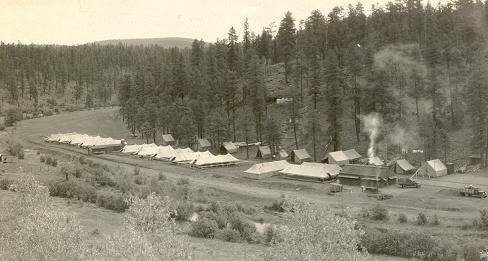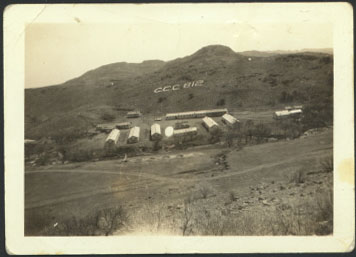



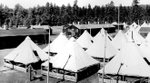
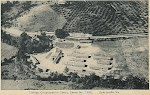
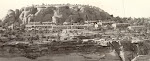
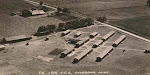
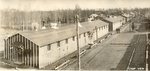
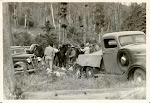
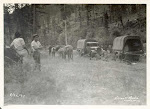
Life in a Civilian Conservation Corps side camp could be rustic to say the least. In this post we'll take a brief look at how the side camps were set up.

While most CCC camps were situated close to the main project site where the enrollees worked, there were also many, many work sites in remote places that needed the attention of CCC workers. It simply wasn’t practical to transport enrollees over miles and miles of remote roads to these work sites, and then return to camp at the end of the workday. To resolve this dilemma, smaller camps known as “spike camps,” “side camps,” or “fly camps” were established. But no matter what they were called, those small non-permanent camps established well away from larger CCC camps, were responsible for an astonishing amount of useful work that otherwise would not have been possible.
Side camps were initially an area of dispute. The technical services wanted the side camps placed under their control, an arrangement that both the Army and director Fechner opposed. Since the operation of the main camps was under their control, the Army reasoned that it should also be in charge of the side camps, with the technical services taking charge of the enrollees during normal work hours.
In July1933, President Roosevelt approved the establishment of side camps and he placed them under the control of the technical agencies with the requirement that not more than 10 percent of the company strength be assigned to them. One reason for Roosevelt’s decision may have been that, to place an army officer in each side camp would have stretched the military organization too thin, leading to a decline in management and leadership throughout the program. Despite their being exempt from direct Army control, there were guidelines on the layout of the side camps. For example, a Forest Service plan for a 25-man camp provided for five canvas tents, each 16 by 16 feet to house the enrollees. Three tents measuring 9 by 9 feet provided shelter for supervisory staff. The mess unit operated out of a tent measuring 19 by 21 feet and additional shelters were provided for the kitchen, the cook, the infirmary and office, as well as latrine and shower facilities. Even in these smaller camps, the provision was always made for a flagpole, usually placed in a central location in the camp area.
Forest Service plans also provided guidelines for a mobile 25-man camp, which consisted of 12 two-man shelter tents, three staff tents, one cook tent and a tent to serve as a combination mess and kitchen. Despite the lack of Army involvement, life in a mobile camp may have been quite similar to life in an infantry platoon. Each man was to be supplied with an infantry pack, canteen and mess kit. In the mobile configuration, the need for a kitchen unit could be eliminated if each enrollee carried five days of rations with him and the crew returned to base camp on weekends to re-provision.
Side camps were initially an area of dispute. The technical services wanted the side camps placed under their control, an arrangement that both the Army and director Fechner opposed. Since the operation of the main camps was under their control, the Army reasoned that it should also be in charge of the side camps, with the technical services taking charge of the enrollees during normal work hours.
In July1933, President Roosevelt approved the establishment of side camps and he placed them under the control of the technical agencies with the requirement that not more than 10 percent of the company strength be assigned to them. One reason for Roosevelt’s decision may have been that, to place an army officer in each side camp would have stretched the military organization too thin, leading to a decline in management and leadership throughout the program. Despite their being exempt from direct Army control, there were guidelines on the layout of the side camps. For example, a Forest Service plan for a 25-man camp provided for five canvas tents, each 16 by 16 feet to house the enrollees. Three tents measuring 9 by 9 feet provided shelter for supervisory staff. The mess unit operated out of a tent measuring 19 by 21 feet and additional shelters were provided for the kitchen, the cook, the infirmary and office, as well as latrine and shower facilities. Even in these smaller camps, the provision was always made for a flagpole, usually placed in a central location in the camp area.
Forest Service plans also provided guidelines for a mobile 25-man camp, which consisted of 12 two-man shelter tents, three staff tents, one cook tent and a tent to serve as a combination mess and kitchen. Despite the lack of Army involvement, life in a mobile camp may have been quite similar to life in an infantry platoon. Each man was to be supplied with an infantry pack, canteen and mess kit. In the mobile configuration, the need for a kitchen unit could be eliminated if each enrollee carried five days of rations with him and the crew returned to base camp on weekends to re-provision.


 The walking tour of CCC sites in Grand Canyon Village begins with the Community Building, just northeast of Parking Lot E. The Community Building was funded with Public Works Administration funds and built with CCC and park labor between 1934 and 1935. The building, which replaced a structure that burned down in 1933, has served as a public library, hosted plays and meetings and served as a theatre for showing movies.
 The next stop on the walking tour is a culvert, located near the intersection of Village Loop and Center Road. The Park Service reports that the exact date of construction of this culvert is unknown but it is believed to be a CCC built structure. Close inspection of the culvert – actually two culverts and stone headwalls – shows that the pipes may have been extended in the process of widening Village Loop at some later date. Evidence of the stone ditch lining is still visible downstream of the culvert outlets. The Park Service literature indicates that this culvert has required little maintenance over its life span; a tribute to the beneficial work of the boys in the CCC.

 From the intersection of Village Loop and Navajo Street, the route of the walking tour proceeds across the railroad tracks, past the train station and up the steps leading to the historic El Tovar hotel. At this point the visitor is on the flat crest of ground immediately adjacent to the south rim of the canyon and if they proceed to the east along the rim to a point between Hopi House and Verkamps Curios they will see a bench carved out of a huge log. The CCC constructed log benches in conjunction with their work refurbishing the rock wall along the rim. It is believe that this massive bench was created in 1934 or 1935, though no documentation exists to provide proof. It seems ironic that, while the CCC boys seldom left visible markings to identify their work, countless Grand Canyon visitors have seen fit to carve their names into this historic log bench, seemingly in an effort to make their own short visit somehow more meaningful.
 Proceed from the log bench in a westerly direction (to your left as you face the canyon) less than 100 feet to the rock wall opposite Hopi House. The walking tour notes indicate that in 1934 and 1935 the CCC completely rebuilt the rock wall along the South Rim from Verkamps Curios to Lookout Studio, replacing a poorly constructed and dilapidated dry wall and a section of wooden fence. The CCC standardized the dimension to 27 inches high and 18 inches wide, with guardrails added in some places. It is worth pointing out that in some places the workers would have been in quite a precarious position as they worked on the wall, but to their credit, no major accidents or injuries were reported as a result of CCC work at Grand Canyon’s South Rim. (Indeed, the only CCC fatalities reported at Grand Canyon were the result of off-duty mishaps that involved a fall from the south rim and a drowning in the Colorado River at the bottom of the canyon.)
 Proceeding along the rim to the west you’ll come to a flagpole at what is called North Rim View. From here you’ll see – barely – the North Rim’s Grand Canyon Lodge. Company 818 worked on the North Rim in the summers, building structures, fences, fighting forest fires and building roads. During the winter months the men were moved to the bottom of the canyon to areas like Phantom Ranch. Phantom Ranch’s Bright Angel Campground was built by the CCC, as were a number of trails including Ribbon Falls Trail and the nine-mile Clear Creek Trail. CCC enrollees also constructed the Colorado River Trail from 1933 to 1936 and while it is only two miles long, it is reportedly the most difficult and hazardous trail ever constructed in the canyon.
 Continue walking westerly to a point in front of Kachina Lodge and you will find a plaque that has been affixed to the top of the stone wall. This plaque commemorates the transcanyon telephone line installed by the CCC. Prior to construction of this transcanyon line, communication between the North and South Rims was unreliable. In order to remedy the situation in 1934, a group of CCC enrollees started from each side of the canyon, working their way towards each other, all the while stringing telephone line on metal poles, down steep cliffs and though narrow gullies, often in temperatures exceeding 100 degrees! When the transcanyon telephone line was completed in 1935 it stretched from the North Rim along North Kaibab Trail to Cottonwood Camp and Phantom Ranch, then across the Colorado River to a spur line on the south Kaibab Trail at a point known as “The Tipoff.” The main line continued along Bright Angel Trail connecting Phantom Ranch to Indian Garden, and then to the South Rim developed area via the rest houses along the trail. The line was used so much that another circuit was added in 1938-1939. The Park Service guide reports that the line included 592 metal poles and, because cell phones do not work with in the canyon, parts of the original telephone line are still in use today. If you look carefully down the slope beyond the plaque on the stone wall, you will see two or more of the metal poles for the telephone line.
 Continue walking west past the Thunderbird Lodge, Bright Angel Lodge and Lookout Studio to historic Kolb Studio. In 1936 the CCC built the stairs that lead up the slope toward the mule corral. The stairs were originally of all stone construction without handrails, however the stone treads have been replaced with concrete steps and for safety reasons, a hand rail in now in place. Proceed up these steps and walk to your right, a few hundred feet to the stone and pipe mule corral and the trailhead of Bright Angel Trail.
 The Park Service walking tour points out that the Bright Angel Trail was used by American Indians long before the first pioneers arrived in the 1880s. The trail was transferred to the National Park Service in 1928, some five years before the creation of the CCC. The CCC undertook major reconstruction of the trail, completing the work in 1939. Originally the trail was only two to three feet wide in places. Using pick, shovel, drill and dynamite, the boys of the CCC reconstructed and rerouted the trail to its current width of four to six feet. Additionally, the CCC built rustic stone and timber shelters long the trail.